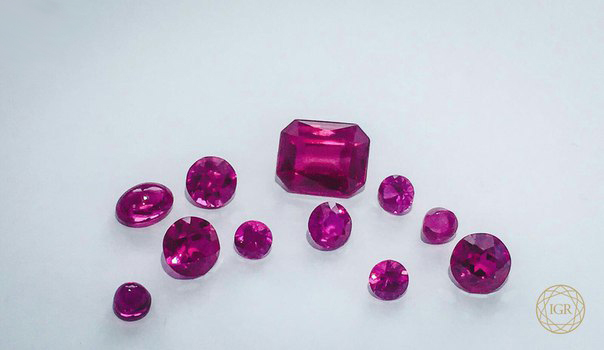
Natural vs synthetic rubies
13.04.16
Natural rubies have been mined for over eight thousand years. It is the hardest gemstone after only the diamond; composed primarily of corundum, which is the crystalline form of aluminum oxide. Chromium gives the ruby its characteristic red color; and the higher the concentrations, the darker its shades.
Natural rubies mostly come from Myanmar, Thailand and Sri Lanka.
The gems have been highly valued in many cultures. It was commonly believed rubies had supernatural protective powers, because of its fire- and blood-like colour.
Large, high-quality rubies are rare; so the value of such ruby can be times higher that of a similar-quality diamond. Also, as rubies are even harder than steel, they are often used for industrial purposes; replacing metal shafts in watches and laser-like devices.
Due to the high demand, artificial rubies are manufactured. About 75% of present ruby production is used for industrial purposes; however, some are still cut as gemstones.
In fact, rubies were the first gemstones to be produced synthetically. The experiments date back as far as 1837; and the first 30 years were rather unsuccessful.
The first synthetic rubies, so-called Geneva ruby, to be sold as gemstones were discovered in the mid-1880-s. The technique behind it remained a mystery for almost a century.
In 1970s, the analysis of remaining stones revealed that they were formed by melting of powdered aluminum oxide with some chromium oxide, and solidifying of this mixture. The technique is being employed up to this day.
Presently, there are two main types of synthetic ruby manufacturing: production from melt and production from solution.
The former requires the powdered material to melt, in order to be easily manipulated further to solidify in a crystalline form. The latter dissolves aluminum oxide and chromium in another material, which then precipitates into the same crystalline form.
The material that subsequently becomes the ruby crystal mostly contains of very pure aluminum oxide and some chromium oxide, which is added for the colour. Therefore, with the exception of some impurities, synthetic rubies have the same physical, chemical, and optical properties as their natural equivalents.
Unlike synthetic rubies produced for industrial purposes, lab-created stones cut as gems are not simply distinguished. Microscopic examination can reveal some patterns of inclusions, bubbles and striations that can help differentiate between artificial and natural stones; even identifying where the stone came from or how it was made.