Do not Judge a Diamond By its Fluorescence!
26.01.17
Fluorescence is a misunderstood and complex feature when purchasing a diamond. As a start to the new year and many special occasions ahead, IGR London would like to give an insight into the controversial topic of fluorescence in diamonds. In this post, the concept of fluorescence will be explained and the practicality of fluorescence.
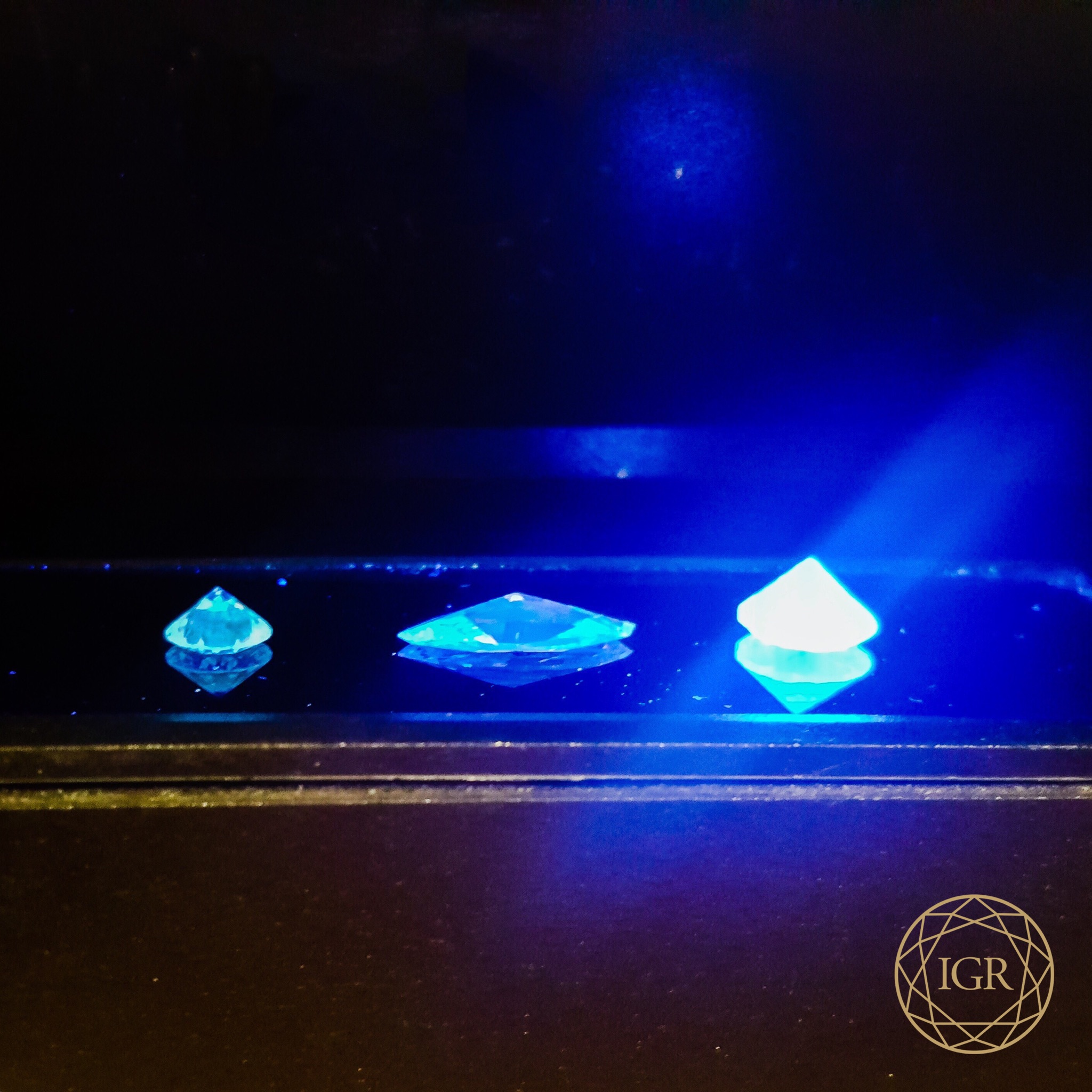
So what is fluorescence? It is the emission of light by a substance when subjected to any electromagnetic radiation. Diamonds show such phenomena under the UV light (200nm-400nm) including the tendency to display stronger fluorescence and colour under long-wave(LWUV) than shortwave(SWUV). The phenomenon is rarely seen under normal viewing conditions, so most people never witness it! Such factor makes the study of diamonds more exciting not because fluorescence exists, but mainly because of its diversity. In fact, two diamonds may look the same in the daylight, yet so different under UV light.
Natural Colourless Diamonds can display a range of fluorescent colours depending on the diamond type. It is noted that 95% of all luminescent diamonds glow brilliant blue. The second most common colour is yellow or green, and other colours such as white, pink, red and orange are rarer. The beaming colour is documented in the grading report. The degree of the fluorescence is categorised as none, faint, medium, strong and very strong.
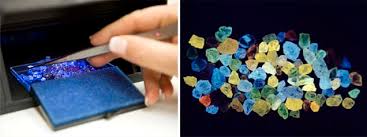
Photo by Erich Welch
The belief that blue fluorescence has a negative impact on diamonds' visual beauty and value is nothing more than a myth. The truth is the magical glowing substance has no aesthetic impact on the stone and should not decrease its value. In the exceptional case of less than 0.2% a "very strong" blue fluorescent diamond may exhibit a bit of hazy, bluish appearance. In certain circumstances the glow may be seen under daylight, gemmologist usually call this effect "over blue". However, if a diamond has yellowish to brownish tone, strong luminescence can mask the hues. For example, the stones appear to be a G-colour in daylight, when in fact, its grade might be I-J when examined under the grading lamp. Moreover, the phenomenon also has a positive effect on fancy coloured diamonds and can increase its value. When the fluorescence colour is the same as the body colour, meaning Green diamond having a green glow or a Yellow diamond having a yellow radiance– this will intensify the stone's colour and enhance its natural glow in direct sun light. Certainly, this feature is considered a virtue rather than a flaw; it will consequently generate a premium price.
Fancy Colour Diamonds can glow in a wider collection of colours than colourless diamonds, due to the presence of different colouring elements. The luminous quality of fluorescence in coloured diamonds complements the body colour, appreciating the magic of colour.
|
Diamond Body Colour |
Type |
Reaction Under LWUV |
Reaction Under SWUV |
|
Natural Yellow |
Type Ia |
Blue, Yellow, Green or Pink |
Weaker colours |
|
Natural Yellowish to Brown or Orangish-Yellow |
Type Ib |
Inert |
Inert to Moderate Yellow, Green Blue or Orange |
|
Natural Blue |
Type IIb |
Inert |
Red Fluorescence and Red Phosphorescence |
|
Natural Pink to Red |
Type Ia Type IIa |
Blue- dull Green |
Weaker Colours |
|
Natural Green |
Type I Type II |
Blue, Green, Yellow, White |
Weaker Colours |
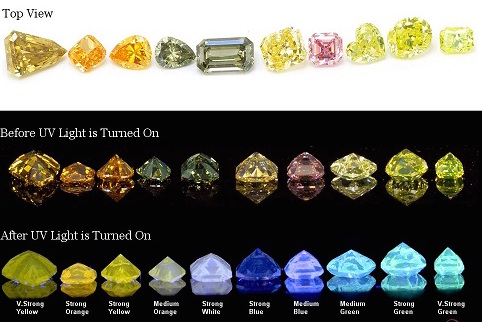
Photo by Leibish & Co.
Testing treated and synthetic diamonds for fluorescence is an excellent method to distinguish natural from enhanced stones and artificially grown diamonds, additionally to categorise the type of treatment and method of synthesis.
|
Diamond |
Reaction of Treated Stones under UV |
Reaction of Synthetic stones under UV |
|
Colourless |
Type IIa HPHT treated: Blue-Violet, Green-Yellow under LWUV, with weaker colours under SW |
HPHT synthetics: LW-Inert, SW-Inert to Moderate Yellow, Green Blue or Orange CVD synthetics: SW-Orange |
|
Yellow |
Type Ia Irradiated and Annealed: greenish under LWUV Type Ia HPHT: strong chalky greenish-yellow under LWUV |
SW- Inert to moderate yellow, green, blue or orange LW-Inert |
|
Blue |
Irradiated: LWUV- Greenish |
SWUV- Inert to moderate yellow, green, orange LWUV-Inert to weak Orange. A typical long lasting mainly white phosphorescence. |
Moreover, checking the stone for the fluorescence can be helpful in gem identification, as it can separate diamond from the range of other colourless materials. For example, common diamond simulant like Cubic Zirconia will glow orange under the long wave and yellow to greenish yellow in short wave. Synthetic Moissanite is another convincing substitute which will be Inert to Greenish Yellow to Orange when subjected to long wave UV.
Some designers and jewellers are choosing to have fun with fluorescent diamonds. Designer, Maria Kovadi has creatively selected diamonds with blue fluorescence in her YouV diamonds collection to create angel wings in the pendant below, which can be seen when UV light is shone.
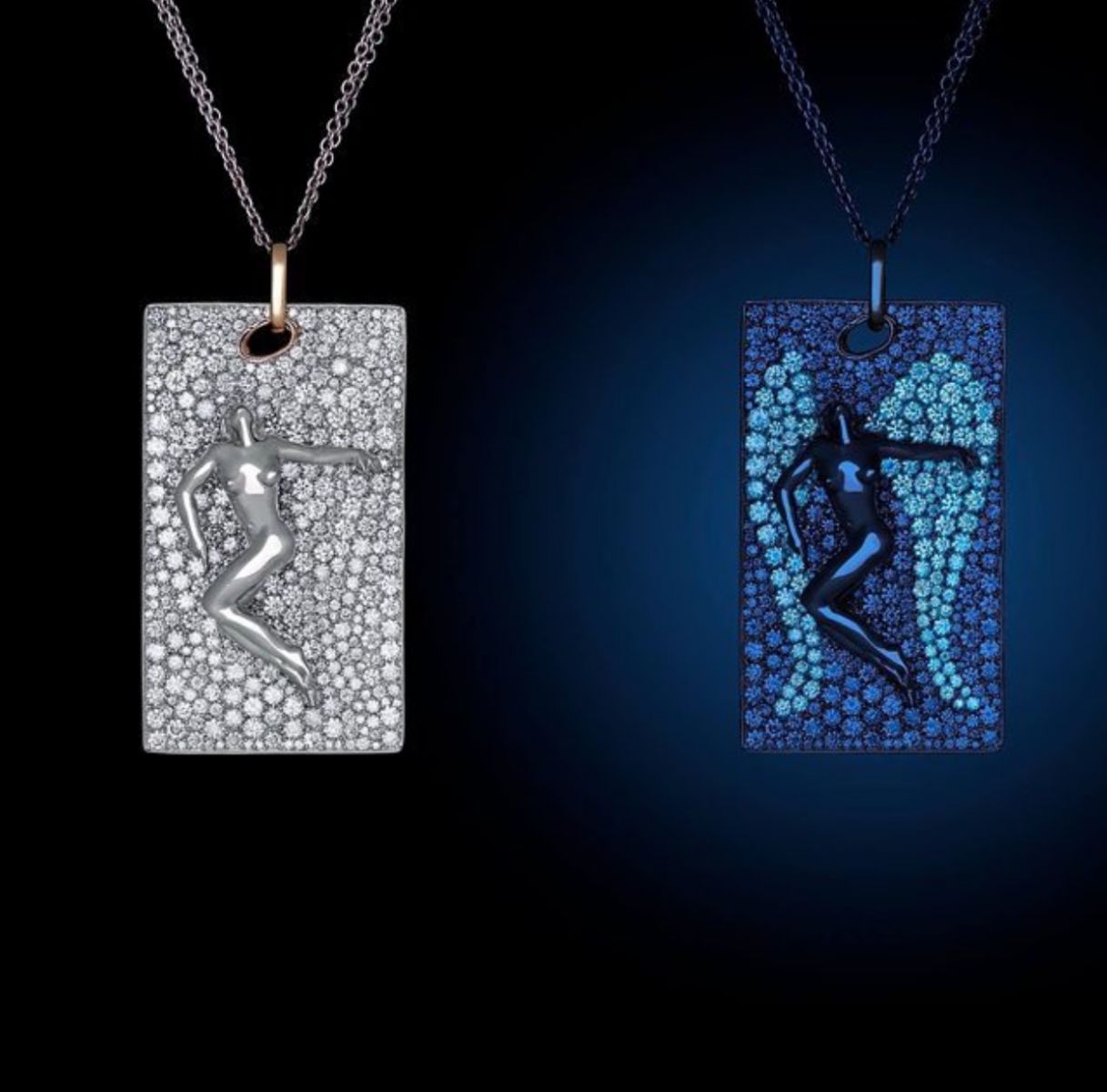
As study shows, fluorescence is an exciting feature that makes diamond more unique. The luminescent glow can enhance the beauty of your stone, so do not judge a diamond by its fluorescence! Hopefully, this blog post will remove some of the negative stigma surrounding fluorescent diamonds.
Zhanna @ IGR London