Burmese rubies
23.04.16
Ruby is red corundum - the most valuable member of the family. All other colour varieties of corundum group are referred to as sapphire. Corundum is the second hardest natural substance, falling short just bellow diamond.
Depending on iron and chromium impurities within the stone, the colour of rubies varies from pinkish or purplish, to orangey and brownish reds. The location of geological formation tends to define the trace mineral content. Therefore, some ruby shades are described by their country of origin.
For example, orangey-red and brownish-red stones mostly come from Africa (Madagascar ruby), while pink-red and purplish red are the colours of Asian sources (Thai or Burmese rubies).
Burmese rubies have earned the reputation of the world’s finest rubies; and are found in a few different areas of the country: Sagyin, Thabeitkyin, Naniazeik, Mogok and Möng Hsu.
Sagyin
Poor-quality rubies have been mined from the marble quarries in Sagyin Hills, 26 km north of Mandalay. The tract was inspected in 1895; and the founded rocks were said to be gneisses and schists with bands of crystalline limestone in them. The latter contained numerous minerals, including spinel and ruby overlying the crystalline limestone. Nowadays, however, Sagyin is now more famous for marble.
Thabeitkyin
Rubies at Thabeitkyin were reportedly mined as early as the 1870s. The gemstone mining area is situated north of Mandalay on the lower slopes of the Shan Plateau enroute to Mogok. In addition to rubies, blue and star sapphires have been recovered from Thabeitkyin.
Naniazeik
Rubies at Naniazeik were discovered in the early 1980s. In addition to ruby, spinel is also found. Metamorphosed limestones were thought to be the source of origin for both the rubies and spinels. Apparently, little work has been recently taking place in the mining area.
Mogok
Mogok's rubies occur in a crystalline limestone/marble. Rubies mined in the area are considered to be the world’s finest rubies due to their exceptional “Pigeon’s blood” colour - a deep blood red with a slightly bluish hue. Such rubies are extremely rare and high in value. Known for their strong fluorescence, Burmese rubies coming from Mogok are the most expensive gems per carat in the world. Rubies like these exist nowhere else on earth. Unfortunately, the production from Mogok has recently slowed down; making Mogok rubies even more special.
Möng Hsu
Möng Hsu is the most recent ruby mining location in Burma. The first rubies were discovered there in 1991 by a local resident who worked as a miner at Mogok. Fortune seekers fled to the area, and the population skyrocketed from eight to over 30 thousand at the peak of mining activity. Initially the deposit has shown great promise. Since the early 1990s, Möng Hsu has been supplying the world with as much as 90% of all facet-grade ruby in sizes of under two carats. Rubies from this area are known to come in bluish or purplish hues which require heat treatment in order to improve the colour and clarity of the gems.
Production from Burmese mines remains small, pushing the prices for Mogok rubies to the record levels. In the meantime, other countries such as Thailand and recently Vietnam keep up with the world’s demand for rubies.
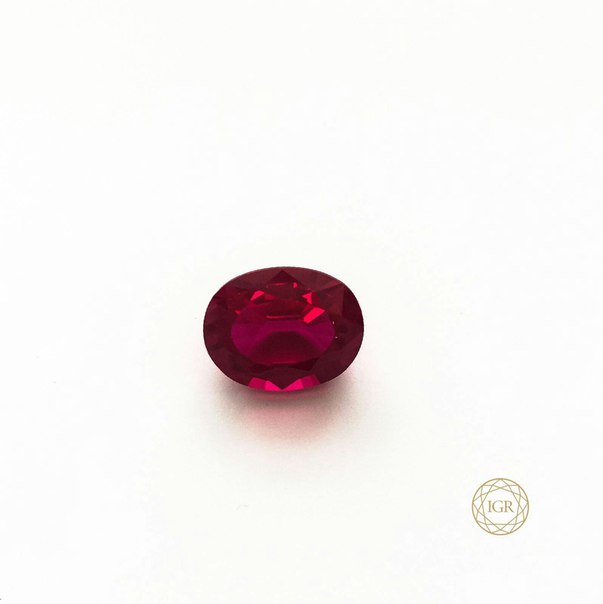
This is a Burmese ruby we had at the IGR laboratory for a gemstone report.
.jpg)